
“The quality of your sleep tonight starts with the light your eyes receive this morning.”
Why Does Morning Light Matter?
For almost all of human history, the rising sun was our alarm clock.
Long before smartphones, alarm clocks and electric lighting, daylight told our bodies when to wake, eat, move and sleep.
Although our lifestyles have changed dramatically, our biology hasn’t.
Deep inside your brain sits a tiny cluster of around 20,000 nerve cells called the suprachiasmatic nucleus (SCN). Often known as the body’s master clock, it coordinates the daily rhythms of nearly every organ and system.
But the SCN doesn’t keep time alone.
Every morning it waits for one crucial piece of information…
Has the sun come up?
Your Eyes Are Measuring Time
Specialised cells in the retina called intrinsically photosensitive retinal ganglion cells (ipRGCs) contain a light-sensitive pigment called melanopsin.
Unlike the cells responsible for vision, these cells are primarily interested in one thing:
How bright is it?
When morning daylight reaches these cells, they send a message to the SCN. That message says:
“It’s daytime. Start today’s programme.”
From that single message, your body begins coordinating thousands of biological processes over the next 24 hours.
The Domino Effect
Morning sunlight doesn’t just help you wake up.
It starts a cascade of events throughout the body.
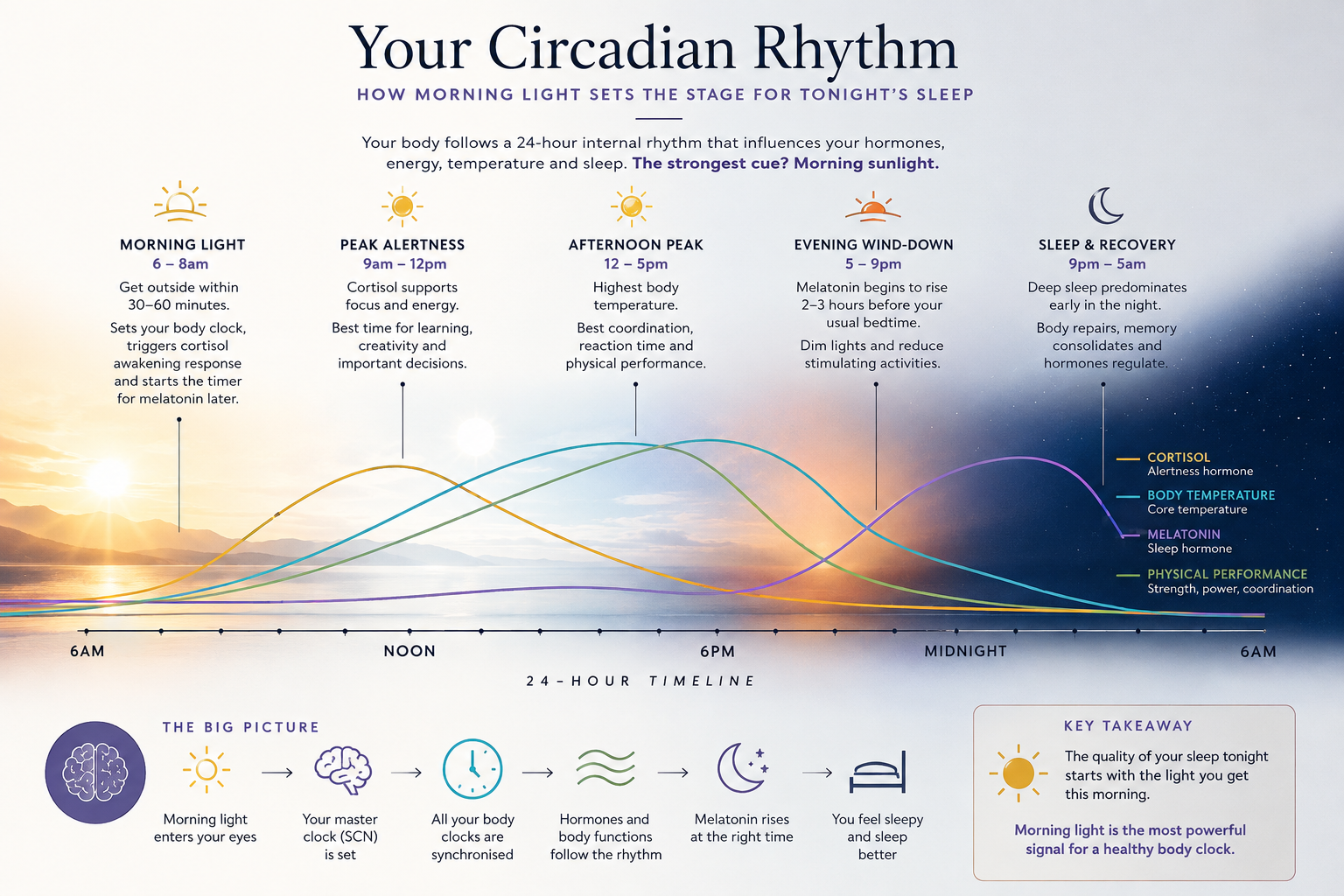
Morning light helps:
- Increase your natural cortisol ‘wake up’ response.
- Raise core body temperature.
- Synchronise clocks throughout the liver, muscles, gut and other organs.
- Improve daytime alertness.
- Set the timing for melatonin release later that evening.
In other words…
Getting morning light can help tell your body when to feel awake and when to wind down.
Why Outdoor Light Matters
Many of us assume sitting beside a window is enough.
While any natural light is helpful, outdoor daylight is dramatically brighter than typical indoor lighting, even on cloudy days.
A well-lit office might provide around 300–500 lux.
A cloudy morning outdoors often exceeds 10,000 lux.
A sunny day may exceed 100,000 lux.
Your body’s circadian system responds to this difference.
That’s why stepping outside for a few minutes after waking can provide a much stronger message than remaining indoors.
What About Sunglasses?
This is where nuance matters.
Dark sunglasses reduce the amount of light reaching the retina.
If your goal is to provide the strongest circadian message, allowing bright natural daylight to reach your eyes for a short period before putting on sunglasses may be beneficial, provided it’s safe and comfortable to do so.
This does not mean staring at the sun or avoiding eye protection when it’s needed.
Protecting your eyes from excessive UV exposure remains important.
The aim is simply to let your brain experience the brightness of a new day.
How Much Light Do You Need?
The answer depends on:
- The season.
- Which you are based on latitude.
- Cloud cover.
- The time of sunrise.
- Your age.
- Your individual circadian timing.
As a simple, practical guide:
☀️ Bright sunny morning: 5–10 minutes
⛅ Typical morning: 10–20 minutes
☁️ Cloudy winter morning: 20–40 minutes or longer
Consistency is more important than perfection.
What Does The Evidence Tell Us?
Research consistently shows that morning light is one of the strongest environmental signals influencing the timing of the human circadian system.
Studies have shown:
- Natural light helps synchronise the body’s internal clock.
- Regular morning light exposure improves circadian alignment.
- Spending more time outdoors can improve sleep timing and quality.
- Exposure to natural light-dark cycles rapidly adjusts circadian rhythms (hint… how to avoid or reduce jet lag!)
Scientists continue to explore how genetics, chronotype, aging and different health conditions influence an individual response to light, but the importance of morning daylight is one of the most consistent findings in circadian biology.
Practical Takeaways
Tomorrow morning:
✔ Go outside within an hour of waking.
✔ Spend 10–15 minutes in natural daylight (adjusting for the weather and season).
✔ Look towards the sky or horizon rather than directly at the sun.
✔ Make it a daily habit.
Sleep doesn’t begin when your head hits the pillow. It begins when your brain sees the morning light.
The Geno 3 Perspective
Modern life has distanced us from many of the natural environmental triggers that shaped human biology.
Morning sunlight is one of the few that remains freely available to almost everyone. It’s simple, costs nothing, and has the potential to influence sleep, energy, mood and recovery.
While it’s not a cure-all, it’s one of the highest-value habits you can build and that’s exactly what Marginal Gains is about.
Further Reading
📖 Recommended Book
Nick Littlehales – Sleep
For those wanting to explore sleep from a performance and recovery perspective, this month’s recommended read offers practical insights from one of the world’s leading sleep coaches.
Also Recommended
- Matthew Walker – Why We Sleep
- Satchin Panda – The Circadian Code
- Russell Foster – Life Time
References
Rather than filling the page with dozens of citations, I’d include a curated list of landmark papers and reviews from leading researchers and institutions:
- Charles A. Czeisler (Harvard Medical School) – foundational work on light as the primary synchroniser of the human circadian system.
- Kenneth P. Wright Jr. (University of Colorado Boulder) – studies demonstrating how natural light-dark cycles realign circadian rhythms.
- Jeanne F. Duffy (Harvard Medical School) – research on circadian timing, ageing and light exposure.
- Reviews on melanopsin and intrinsically photosensitive retinal ganglion cells (ipRGCs) published in leading journals such as Nature Reviews Neuroscience and Annual Review of Vision Science.